


















Size It Up
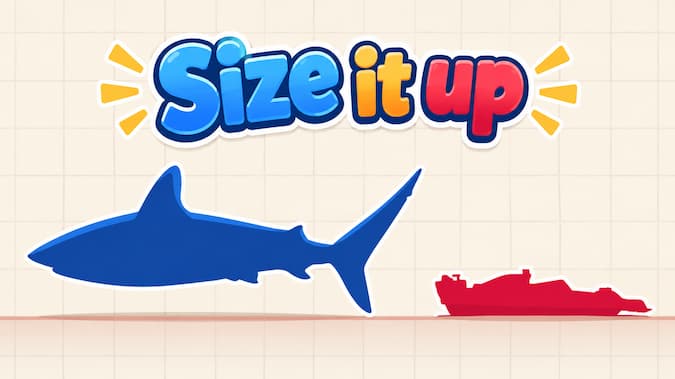
If you like to observe and estimate, Size It Up is a visual puzzle game for you! The game does not ask you to remember the exact length or size of an object. Instead, it shows you two images and asks you to guess their relative size when placed next to each other.
Each round features a reference object with a fixed size. The other object is adjustable. Your task is to drag or resize the target object so that the ratio between the two reflects their real-world proportions as closely as possible.
How do you play Size It Up?
The game is all about visual estimation skills. You don’t have to put in any specific numbers or do any complicated calculations. Simply observe the reference object, visualize the actual size of the other item, and adjust the target object accordingly.
Observation of reference object
Before each question there is an image of fixed size. Consider this the ruler of the level. Having a good idea of this object's size makes it easier to visualize the second object.
Adjust the target size
After viewing both objects, ask yourself whether the object being measured should be half the length, equal to, double, or many times larger than the reference object. Then, resize the target object until the ratio between them feels right.
See the results
When you make a choice, the game reveals the real ratio. Your judgment is. You can earn up to 100 points per round.
How many rounds are there per day?
Each daily challenge has five comparisons. Each question is worth a maximum of 100 points, for a total possible score of 500 points. You may be surprised by the objects in the game. Familiar animals, vehicles, landmarks, or objects that seem deceptively simple to guess can sometimes have actual dimensions that differ vastly from initial impressions.
Tips for More Accurate Predictions
- Think big: Estimate how many times larger the target object is compared to the reference object.
- Use familiar things as a standard: knowing the relative size of the reference object helps to visualize the other object.
- Look beyond surface area: A long, slender object might occupy less area than a short but bulky one.
- Be aware of which dimension is being compared: Think about the length, height, or size that the question is asking about, not the shape as a whole.
- Don’t be fooled by shape: Extra detailed outlines or objects with huge main bodies can give the illusion of being bigger than they are.
- Learn from incorrect guesses: Surprising results help you develop a better sense of actual scale for future rounds.
Size It Up Other Editions
Besides the main version, the size-estimation concept was adopted to special themes. Pop culture deals with characters and objects from popular culture, while geography shifts the focus to geographical locations and landforms.
Discuss Size It Up